
Houston County Court-Level Bench Warrants
Houston County has two district courts, a County Court at Law, two JP precinct courts, and five municipal courts. Each handles its own settings and records. District-level matters route through the coordinator and District Clerk; county misdemeanors or family matters may belong with the County Court at Law.
The County Court at Law page describes its criminal and family jurisdiction and gives a coordinator route. A county courthouse visit alone does not identify which judge can recall a bench warrant.
See the County Court at Law contact page before calling.
The court contact image shows the office route, not a warrant list or a promise about walk-in handling.
For felony files, see the District Clerk's official records page, which describes its record role and case-search route.
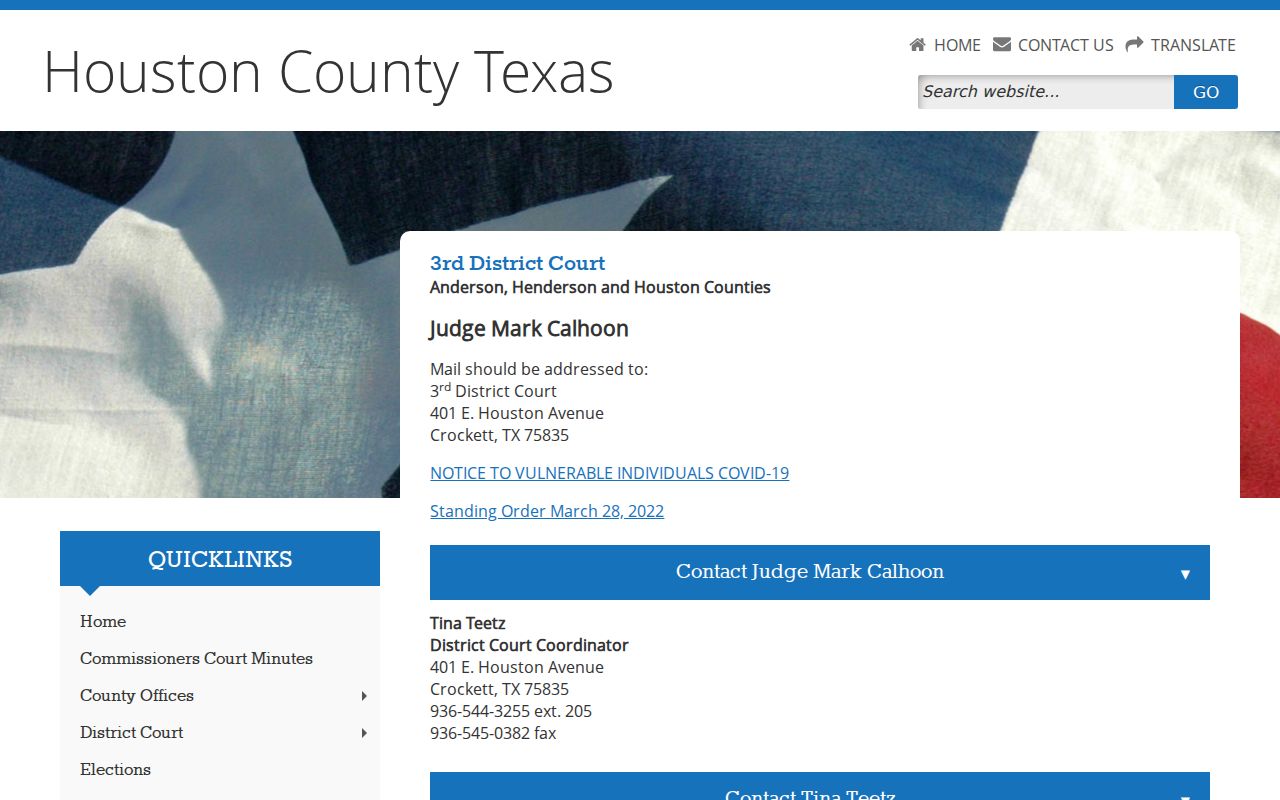
The district-court image provides court context; it is not a searchable warrant list or a current status result.
Houston County Bench Warrants Explained
A bench warrant is court process tied to a missed setting or another failure to comply. In Houston County, that can follow a missed initial appearance, a later hearing, a court order, a bond condition, or a child-support enforcement setting. The issuing court controls its own label and remedy.
Unpaid fine judgments follow a separate path. A capias pro fine is a post-judgment collection process, not the same thing as a probable-cause arrest warrant. Ask the clerk which document is in the case.
Houston County Missed-Setting Process
When a person misses a setting, the docket may show a failure to appear before any public-facing system shows a warrant. The court can issue an alias or bench warrant under its procedure. HCSO's website does not publish a searchable bench-warrant list or a status feed.
For a family matter, route the question to the County Court at Law or the District Clerk's office that holds the case. Child-support enforcement should not be treated as a traffic citation.
How Houston County Bench Warrants Are Issued
The court sets the obligation and decides whether a warrant or another order follows a missed date. Its clerk maintains the docket; a sheriff, constable, city police officer, or marshal may serve process depending on the case. Houston County does not publish one countywide service table.
When the warrant issues, ask the clerk for the court, cause number, issue date, and required appearance. A docket entry is not a complete service-status report. The court must confirm whether the order remains active or has been recalled.
Houston County Capias Pro Fine Recall
For a fine-only judgment, Texas law requires notice and an ability-to-pay process before a capias pro fine can issue. The OCA bench card says the court must recall it when, before execution, a person reports difficulty paying or voluntarily appears and makes a good-faith effort to resolve the amount owed.
Possible alternatives include a payment plan, community service, community supervision, or an indigency finding where allowed. The card explains statewide procedure, not a local standing order, so ask the JP or city court how it applies.
Bench Warrants and Arrest Warrants Compared
Both may authorize an arrest, but they start differently. A bench warrant usually responds to a missed court obligation. An arrest warrant follows a magistrate's probable-cause review of an alleged offense. The court's case label determines the next step.
| Feature | Bench Warrant | Arrest Warrant |
|---|---|---|
| Trigger | Missed setting, order, or compliance step. | Probable cause for an alleged offense. |
| Who issues | The judge handling the pending case. | An authorized judge or magistrate. |
| Case status | Usually tied to an existing court matter. | May begin before an initial appearance. |
| Next step | Ask about reset, recall, or required compliance. | Ask about counsel, bond, and appearance. |
Houston County JP Bench Warrant Routes
Judge Mike McCreight's JP Precinct 1 court is at 700B South 4th Street, 936-544-2564. Judge Ronnie Jordan's Precinct 2 office is at 110 East Houston Avenue, 936-544-3255, extension 269. The county page does not map citations to precincts.
Use the precinct named on the ticket or ask the clerk to identify it from the cause number. A sheriff inquiry can help with service or custody, but the JP judge controls a recall or reset.
Resolving a Houston County Bench Warrant
Start with the court, not the sheriff, because the issuing judge controls recall. Explain the missed date and ask whether a reset, motion, bond, or court appearance is required. If the case involves a fine-only judgment, ask about hardship and payment alternatives before assuming full payment is the only option.
- Find the court and cause number from the citation, docket, or clerk.
- Call before appearing and ask about the warrant label, bond, recall motion, and next date.
- Ask counsel to contact the court if the charge or risk is unclear.
- Use the remedy the judge approves, then request written confirmation of the warrant status.
Caution: Houston County publishes no walk-in safe-harbor rule; call the issuing court or an attorney before arriving at an office.
Crockett Bench Dates Are Not Surrender Windows
Crockett Municipal Court sessions are listed for the first and third Wednesday, from 1:30 p.m. to 5 p.m. That schedule is for court business, not a warrant-clearing desk or a guarantee that a person can appear without arrest.
Contact the clerk about a fine, date, or procedure before traveling. The court page publishes its own contact route at Crockett Municipal Court.
Finding the Houston County Court That Issued a Bench Warrant
Houston County bench warrants can come from the 3rd or 349th District Court, County Court at Law, JP Precinct 1 or 2, or a city municipal court. The District Court coordinator is at 936-544-3255, extension 205; the County Court at Law coordinator is at extension 230.
District Clerk records route through extension 235 and the County Clerk criminal deputy through extension 242. For a city ticket, contact the city court named on it. A Houston County warrant lookup begins with those case identifiers, but the issuing court confirms status.