
Houston County Arrest Warrant Issuance
Texas Code of Criminal Procedure Article 15.01 defines an arrest warrant plainly: a written order from a magistrate to a peace officer or named person. Article 15.02 sets the essentials. The document must name the person or give a definite description, state the offense, and carry the magistrate's signature. A complaint or sworn affidavit usually carries the facts to the magistrate. Houston County posts no single local intake sequence. Ask the issuing court or your attorney which path applies to a specific case, and read Texas Code of Criminal Procedure Chapter 15 for the full text.
Houston County Arrest Warrants Explained
An arrest warrant lets an officer take a person into custody. A summons only orders an appearance. A bench warrant, by contrast, follows a missed setting or other court obligation. The issuing court controls the process and its status. In Houston County, the court level tracks the alleged offense: felony matters route through a district court, while lower-level and city cases may sit with the County Court at Law, a JP court, or a municipal court.
Houston County Felony Warrant Records
The District Clerk keeps Houston County's felony records and prepares warrants or commitment documents in criminal matters. The office links to LGS records. That link offers no public warrant-specific search fields. For a district case, call 936-544-3255 and ask for extension 235 at the District Clerk, or extension 205 for the district-court coordinator. The District Clerk page gives the official route to the record.
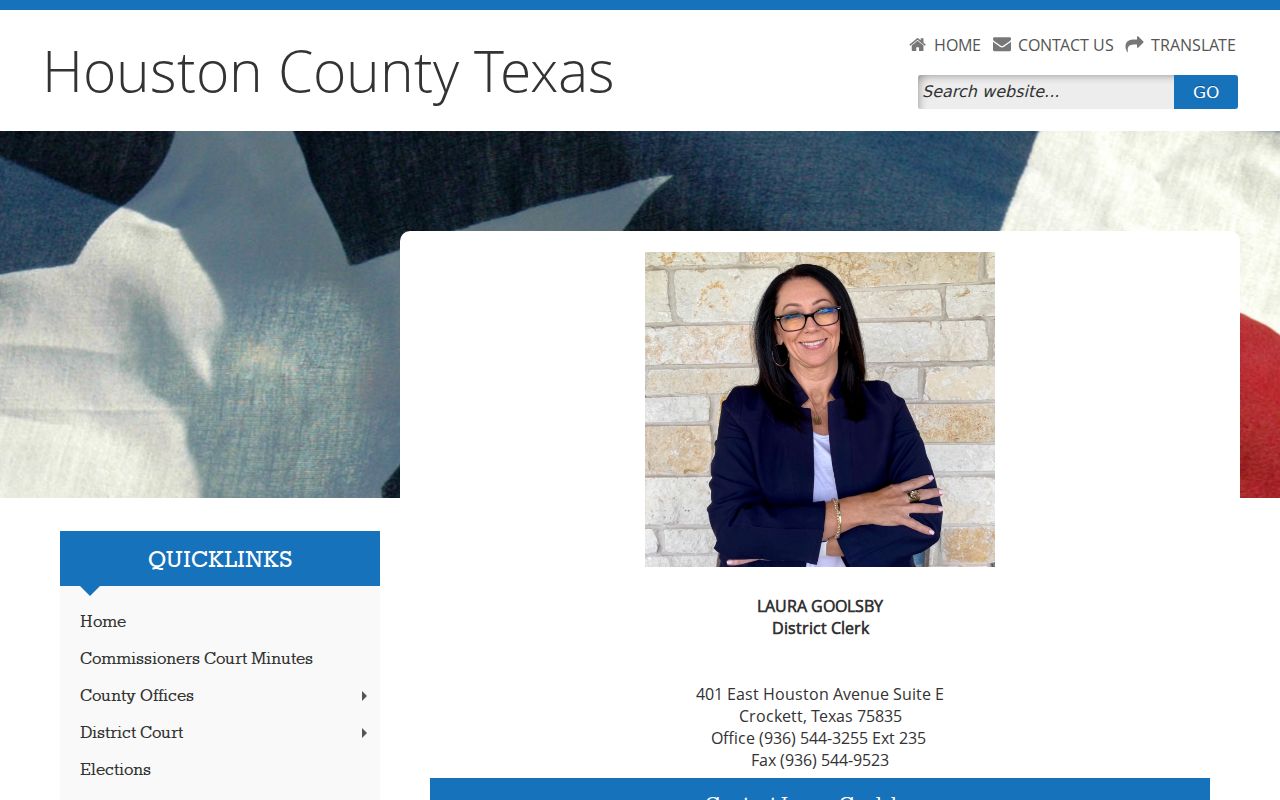
What appears here is Houston County clerk's office contact information, not a sample warrant and not a live warrant lookup.
Inside a Houston County Arrest Warrant
Houston County publishes no public arrest-warrant list to inspect. The fields below are questions for the issuing court. They are not a guaranteed local layout or warrant-number pattern. Ask for the cause number. Ask whether the document is sealed or falls under an access exception. A record showing the warrant's issue does not prove it remains active today.
| Warrant identifier | No public sample located |
|---|---|
| Cause number | Ask which case file holds the order. |
| Offense | Confirm the charge and classification. |
| Issuing magistrate or court | Identify who can answer status and bond questions. |
| Bond | No countywide schedule was found; request the current decision. |
| Issue and return dates | Ask whether the order was executed, returned, or recalled. |
Houston County Warrant Service Officers
A sheriff, constable, or city officer may execute process. Houston County publishes no assignment table matching units to warrants. The issuing court can tell a caller which agency received the order. Two district courts sit here. The 349th District Court and the 3rd District Court both serve Houston County. Their coordinator answers at 936-544-3255, extension 205. The 349th District Court page lists the judge and contact details, though a contact page never shows whether a named warrant is sealed or assigned for service.
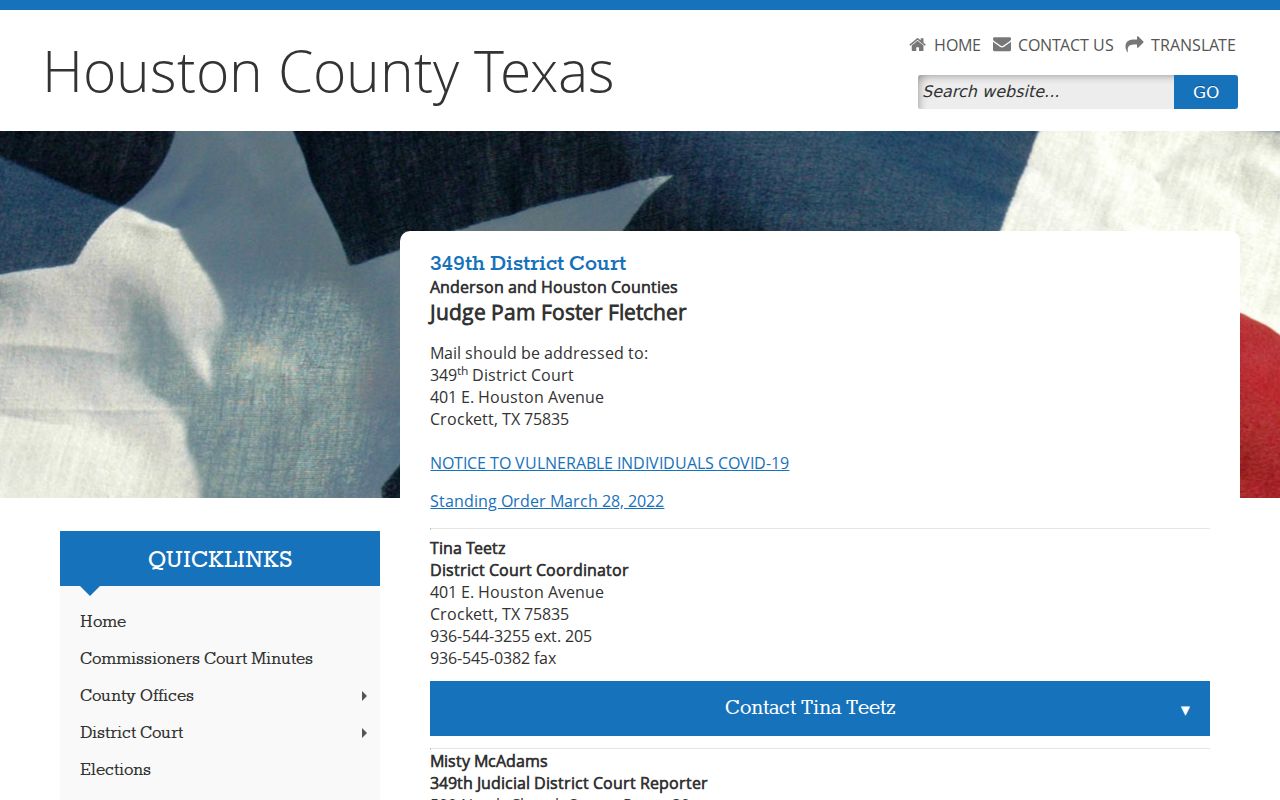
The district-court page gives a contact path; it is not a public warrant roster.
Serving Arrest Warrants in Houston County
Issuing and serving a warrant are different jobs. A judge or magistrate signs the order, a peace officer executes it, and the clerk keeps the court file. In Houston County, the HCSO, constables, the Crockett Police Department, another city officer, or a task force may take part depending on the matter. After an arrest come booking and magistrate review. The court sets bond or other release terms. It may also require another appearance. The county posts no single surrender address, bond desk schedule, or rule promising that a walk-in avoids arrest.
Federal Warrants Beyond Houston County
A federal warrant is not a Houston County court record. Federal questions belong to a separate system. Houston County sits inside the Eastern District of Texas service area. Route those questions to the U.S. District Court, the U.S. Marshals, or federal counsel. PACER shows docket entries. It is not a public self-search for unserved warrants. The Eastern District of Texas, Tyler Division page lists a regional courthouse contact, the U.S. Marshals' Joint East Texas Fugitive Task Force is another federal service route, and a county sheriff's site cannot confirm every federal or out-of-state matter.
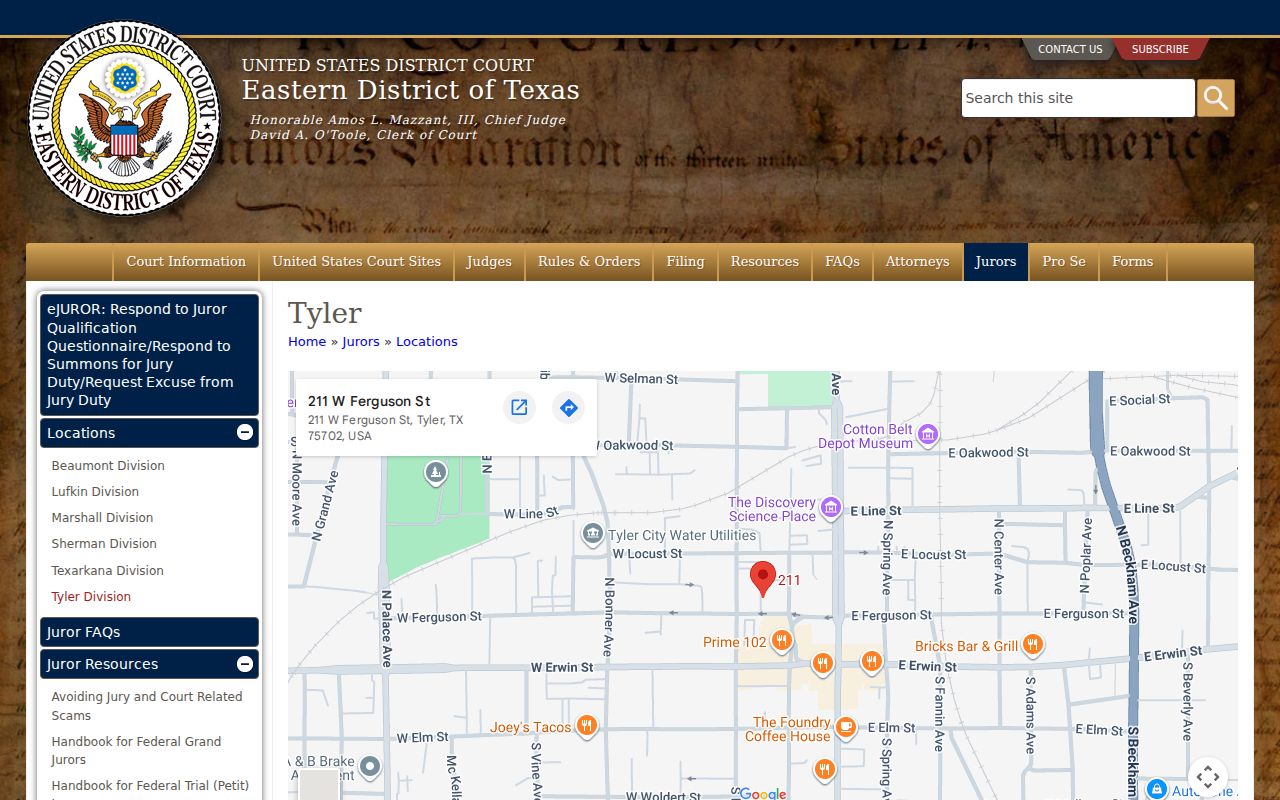
Houston County records end at the federal line; this page points to the separate district system, not to any warrant or person.
Comparing Arrest, Summons, and Bench Warrants
A summons calls for an appearance. An arrest warrant commands custody instead. A bench warrant follows a missed setting or court obligation. If the docket shows a missed date, the Houston County bench warrant steps explain the court route.
| Feature | Arrest Warrant | Summons | Bench Warrant |
|---|---|---|---|
| What it orders | Arrest and custody. | Appearance at a stated time. | Return to court after noncompliance. |
| Basis | Probable cause of an alleged offense. | A court-directed response. | Missed appearance or order. |
| Who issues | Authorized judge or magistrate. | Court or authorized officer. | Judge handling the pending case. |
| Response | Ask counsel and court about bond or appearance. | Attend as directed. | Ask the issuing court about reset or recall. |
Houston County Bond and Warrant Recall
Houston County posts no countywide bond schedule. No universal payment desk or walk-through policy exists either. Ask the issuing court or magistrate directly: is bond available, who accepts it, what amount and type apply, and can counsel request a recall or set an appearance? A bond secures release or a future appearance. It does not dismiss the case. After a court action, confirm the warrant status and next date with the clerk. If the matter may be federal, contact federal counsel or the relevant federal office.
If There's an Arrest Warrant for You
Start with a phone call, not a drive. An attorney can also contact the issuing court and verify the cause number, warrant type, status, bond, and any required appearance. Houston County publishes no safe-surrender promise, so ask where to go and how the process works before you visit an office. Counsel can then press for a scheduled appearance, bond, or a motion to recall or quash. Once you are released, track the new court date. Ask the clerk what remains open. A recall or bond ends the warrant process only; the underlying criminal case continues unless the court resolves it separately.
Important: Before appearing, ask counsel or the issuing clerk whether the court requires a bond, a scheduled surrender, or another step.